
Knowth Passage Tomb
Neolithic Grave, Brú na Bóinne
Megalithic art & architecture
CONTENTS
- Summary
- Megalithic Structure
- Megalithic Art
- Interpretation of Knowth's Art
- Excavation
- History
- References

Summary
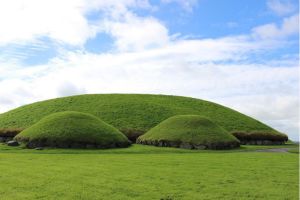
Knowth Passage Tomb is the largest of all Neolithic tombs found at the UNESCO World Heritage site of Brú na Bóinne in County Meath, Ireland.
It consists of a large cairn (or mound), known as Site 1, along with eighteen smaller satellite tombs.
The Knowth passage grave was built by Neolithic farmers and labourers towards the end of the fourth millennium BC, probably after the construction of Newgrange Passage Tomb (3,200 BC) but before the construction of the Dowth monument.
Knowth is world famous for its carved rock art, which - like many other passage tombs of the time - features similar abstract signs to those used in caves since the arrival of modern humans in continental Europe.
The exact function of the Boyne Valley tombs remains obscure, but these monumental structures with their gigantic megaliths and intricate symbols must surely have served as important centres of Stone Age culture in the region.
Megalithic Structure
The megalithic architecture of Knowth is not much different to that of Newgrange. The mound at Knowth rises about 12 metres (40 ft) in height and measures roughly 67 metres (220 ft) in diameter. It covers an area of about one hectare (2.5 acres).
Beneath the mound there are two passage tombs, each leading to a separate cruciform burial chamber, which are independent of each other with entrances on diametrically opposite sides, east and west.
The passage walls are made up of large monoliths known as orthostats, which range from 1.5 metres to 2 metres in height.
The passages are built along an east-west line, and were likely aligned with the sun or moon, although earth slippage and new construction work has made it impossible to investigate this issue any further.
The western passage is 34 metres long and ends in a burial chamber without any recesses or alcoves. The doorway to the burial chamber from the passage is marked by a large sill stone.
The chamber's original granite basin stone was removed at some point and repositioned about two-thirds down the passageway.
The eastern passage is 40 metres long - twice the length of the Newgrange passage - making it the longest megalithic passage in Western Europe.
It ends in a two-tier cruciform chamber with a high corbelled roof whose ascending sides gradually narrow beehive-fashion to a final capstone at the top. There are two side recesses and an end recess.
The right-hand recess is more richly ornamented with rock engravings than the others, and contains a large granite stone basin (one metre in diameter), decorated outside and inside with linear patterns. (The basin stone was the receptacle for the burnt or unburnt bones of the dead.)
Outside, the base of the cairn is ringed with over 120 oblong kerbstones - huge greywacke boulders, each about 2.5 metres (8 ft) in length - many of which are decorated with abstract signs, including numerous petroglyphs with spirals and other curvilinear designs.
For a comparison with Ancient Egyptian architecture of the Bronze Age, see: Egyptian Pyramids (from 2670 BC).
Megalithic Art
Professor George Eogan who first excavated the site, stated that Knowth had the largest collection of megalithic art known. Indeed, experts have estimated that the site contains more than one quarter of all megalithic carvings produced in Western Europe.
More than 200 decorated stones were uncovered during excavations. Most of the decorations are found on the huge kerbstones, particularly those near the entrances to the passages, which feature an elaborate series of angular and spiral inscriptions.
In addition, many of the passage orthostats are dressed and decorated with a variety of abstract images. The right-hand recess of the eastern burial chamber contains an astonishing amount of stone carvings.
The most common motifs include circles, lozenges, spirals, rhomboids, serpentiforms, crescents, and ovals.
In addition, some researchers believe the images include direct representations of the moon (circles, crescents), the sun (circles with rays), and even a lunar map.
A significant amount of this artwork was found on the reverse of the stones; a form of megalithic decoration known as 'hidden art'.
This raises interesting questions about the motivation of the artists, although it is perfectly possible that they simply recycled the stones and reused the blank side.
Archaeologists also uncovered artifacts dating to the earlier Neolithic, around 4,000 BC. These include, stone tools, as well as ancient pottery and domestic hearths.
Interpretation of Knowth's Art
The time and effort required to decorate the stones at Knowth suggests that the art was of great significance to the builders and their community.
Unfortunately, this deduction tells us nothing about the meaning of the carvings, which we can only interpret through the filter of our post-industrial culture.
And, as we know from many attempts to understand the phenomenon of prehistoric cupules, trying to interpret carvings created during the Stone Age, thousands of years ago, is next to impossible without detailed knowledge of the cultural context.
But of course numerous explanations have been offered.
Some people have suggested that many of the incised symbols are therianthropic in nature: they believe the spirals represent the eyes of gods associated with places of burial. Others attribute these motifs to a sun-based faith.
Some scholars believe that Knowth's geometric images were created by individual artists when experiencing an altered state of consciousness, a theory often applied to Upper Paleolithic art by Cro-Magnons.
This is based on the fact that certain Shamanistic rituals involved prolonged drumming, chanting, or ingestion of hallucinatory plants, and so on.
Someone who enters an altered state of consciousness, may create certain types of shapes, such as the circles, dots-in-circles, spirals, wavy lines and other concentric motifs that we see in megalithic tomb art.
Other researchers, such as Martin Brennan, believe that the rock art at Knowth has a lunar or astronomical basis.
He believes he has identified numerous connections between Knowth's megalithic decorations and the moon and stars, including the oldest known map of the moon, as well as calendars based on the positions and the rhythm of the movements of the sun and moon.
Brennan's views are based partly on the assumption that the plentiful food supply of the Boyne Valley region afforded enough time for non-urgent pursuits, like astronomy and time keeping.
Other scientists are more circumspect. They prefer to see the art as purely decorative, irrespective of its complexity and sophistication, much like the geometric patterns of endless variations, as seen in Islamic art.
Knowth's ancient art, they might say, does not need a deeper meaning in order to serve as a beautiful backdrop for funerary or spiritual ceremonies.
See also: Meaning of Cave Art.
Excavation
The Knowth archaeological site was briefly examined in 1941 by Robert Macalister (1870–1950), professor of Celtic Archaeology at the National University of Ireland.
However, little was discovered about the passage tomb or its prehistoric art.
Later, in 1962, a major excavation began, headed by Professor George Eogan of University College Dublin.
Within a decade the team had uncovered both the passages and burial chambers, as well as the decorated kerbstones - in all, one of the greatest assemblages of megalithic art.
These discoveries enabled archaeologists and other scholars to build up a picture of this historic ceremonial necropolis.
History
Despite the erection of certain timber and earth works during the Bronze Age, scholars believe that Knowth - like Newgrange - ceased to function as a spiritual or ceremonial centre during the second millennium BC, and was abandoned altogether during the early era of Iron Age art in Europe, around 250 BC.
Thereafter, for 2,000 years, the great tombs of Newgrange, Knowth, and Douth and the 35 others in the surrounding area, were forgotten and their surfaces used either as fortifications or pastureland until the rediscovery of Newgrange in 1699.
Even then, Knowth was left largely undisturbed up until 1939, when the Brú na Bóinne complex was taken over by the state.
Famous Sites of Megalithic Art
- Göbekli Tepe
9,500-8,000 BC
Şanlıurfa, Turkey. - Nevalı Çori
8,620-7,500 BC
Şanlıurfa, Turkey. - Cromlech of Almendres
6,000 BC
Évora, Portugal
The largest arrangement of menhirs on the Iberian Peninsula. - Gavrinis Passage Tomb
4,200-4,000 BC.
France. - Stonehenge Stone Circle
3,000-2,000 BC
England
NEXT: Timeline of Prehistoric Art (from 540,000 BC).
References
(1) "Neolithic Lunar Maps at Knowth and Baltinglass, Ireland". Stooke, Philip J. (1994). Journal for the History of Astronomy. 25: 39–55.
(2) "Post-Roman Britain to Anglo-Saxon England". O'Brien, Elizabeth. British Archaeological Reports, 1999. 27. ISBN 978-1-8417-1118-8.
(3) "Newgrange and the Bend of the Boyne". Stout, Geraldine. Cork: Cork University Press, 2002. 76. ISBN 978-1-8591-8341-0.
(4) "The Stones of Time: Calendars, Sundials and Stone Chambers of Ancient Ireland." Inner Traditions. 1994 ISBN 978-0-8928-1509-8.
(5) "Guide to the National Monuments of Ireland." Harbison, Peter. (1970). Gill & Macmillan. ISBN 100717132390.