
Lascaux Cave Paintings and Layout
Main chambers, layout of rock art
Hall of Bulls, Axial Gallery, Apse
CONTENTS
- Benchmark for Cave Painting
- Facts About Lascaux
- Basic Plan of Lascaux Cave
- Hall of the Bulls
- Axial Gallery
- The Passageway
- The Apse
- The Shaft
- The Nave
- The Mondmilch Gallery
- The Chamber of the Felines
- Abstract Signs at Lascaux
- References

Benchmark for Cave Painting
Prehistoric art reached its apogee at Lascaux and Altamira, the twin peaks of Franco-Cantabrian art of the Upper Paleolithic.
Together with Chauvet Pont d'Arc in the French Ardèche, these sites represent the benchmark for cave art of the last Ice Age.
In this article, we examine the parietal art of Lascaux, its chronology and layout, as well as some of the artistic techniques used by the artists.
We list each of the seven chambers of Lascaux together with the major cave paintings and engravings they contain. But first, some facts about the cave and its art.
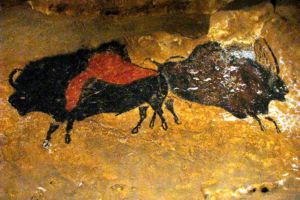
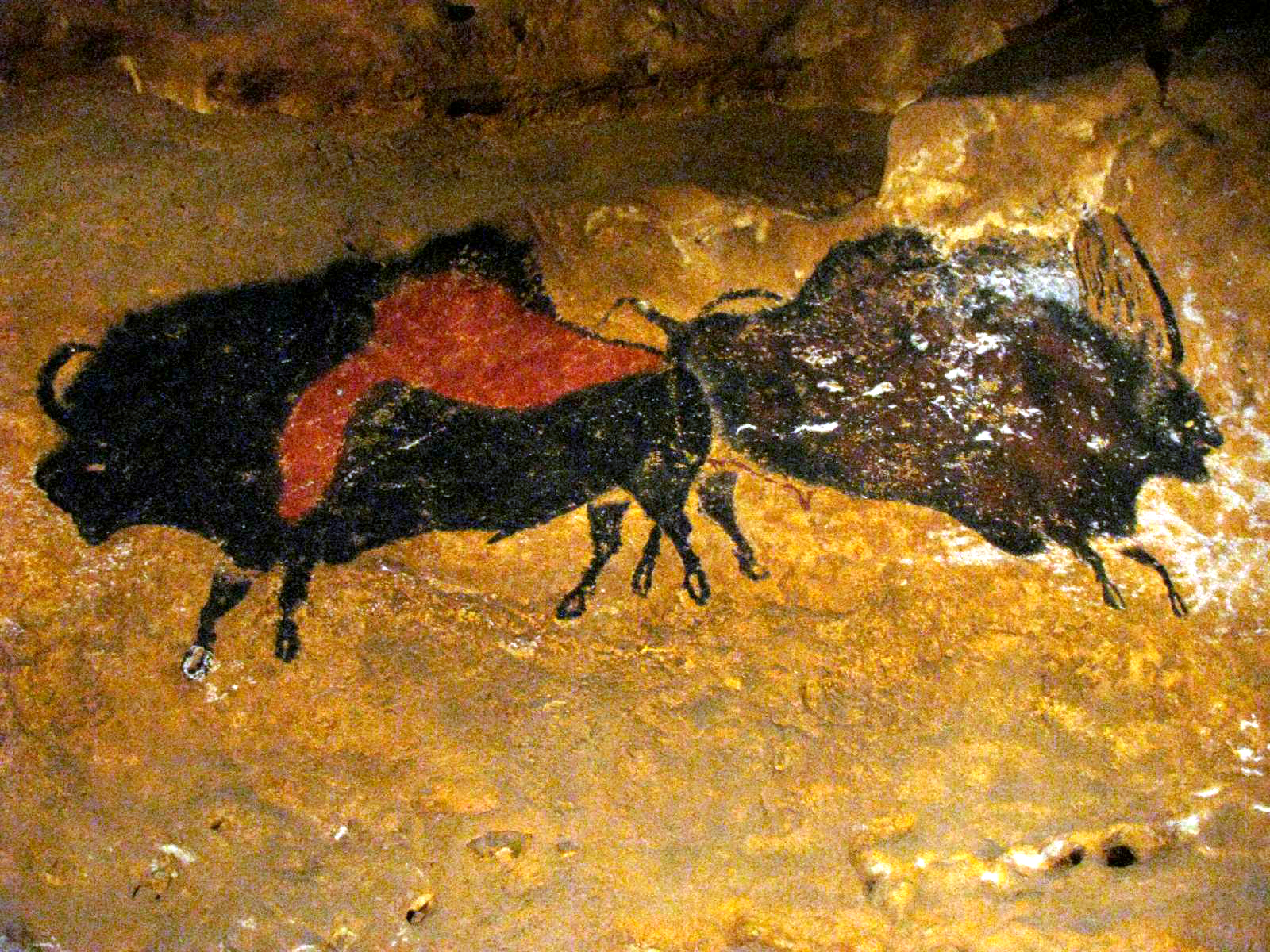
The famous Crossed Bison in the Nave at Lascaux. Image by Don Hitchcock 2008. Source: Display at 'Lascaux Révélée'.
Facts About Lascaux
- The cave is located near the village of Montignac, in the Dordogne of southwestern France.
- Its galleries stretch for about 235 metres, and contain more than 2,000 images, of which 600 are paintings of animals. The animals most often depicted are horses, followed by stags, bulls and other bovines.
- The Stone Age colour palette used by artists at Lascaux, features a comparatively wide range of ochre pigments (red, yellow, purple, brown), as well as black manganese and charcoal.
- Scientists believe the cave was first occupied about 20,000 BC, and that its art was produced over a period of 6,500 years, between 19,500 and 13,000 BC.
- About 13,000 BC, a rockfall sealed the cave completely until its rediscovery in 1940.
- None of the paleolithic art in the cave has been dated directly, because (undateable) manganese was used for black colours, instead of (dateable) charcoal.
- Archaeologists have therefore relied upon indirect dating methods (dating of cave deposits, and a close comparison of painting styles with other dated sites) to ascertain its antiquity.
- The current belief is that the oldest art at Lascaux dates to the Solutrean culture, about 19,500 BC, while other paintings and engravings date to Magdalenian culture, the final phase of the Paleolithic.
- In 1979, in recognition of its status as a major centre of Upper Paleolithic art, Lascaux became a UN World Heritage site, along with 37 other Vézère Valley caves.



Basic Plan of Lascaux Cave
There are seven main chambers in the Lascaux cave.
- The Hall of the Bulls.
- The Axial Gallery
- The Passageway
- The Apse
- The Shaft
- The Nave
- Mondmilch Gallery
- Chamber of the Felines
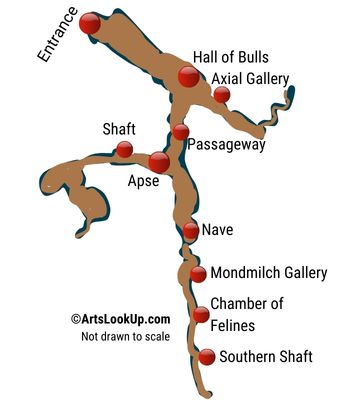
Fig 1. Lascaux Cave Layout.
Note: Lascaux is not decorated in an even manner. The Apse, for instance, contains more than half of all the rock art in the cave but only accounts for 6 percent of its area. The second most heavily decorated chamber is The Passageway.

A mighty swirl of animals. Horses and a huge aurochs, in the Hall of the Bulls, Lascaux Cave. Image by Jack Versloot. (CC BY 2.0)

Hall of the Bulls
The "Hall of the Bulls" (also called the "Rotunda") is arguably the world's most famous underground gallery of Stone Age art.
It measures 19 metres in length and between 5.5 metres and 7.5 metres in width. Its calcite walls are not suitable for engraving, so paintings are the only art.
The Hall of the Bulls contains a huge frieze of 36 animals which circles the gallery. The frieze includes 17 horses, 11 bovines, 6 stags, 1 bear and the fantastical unicorn. Some of the figures are up to 5 metres in length.
Famous pictures include the mysterious Unicorn, the Frieze of the Black Horses, the Frieze of the Small Stags, the heads of some six bulls, a headless horse, and a bear.
The unicorn bears little resemblance to the legendary animal of that name. It even has a pair of straight horns. Its body appears awkward with a pregnant belly, heavy legs, a short tail, a hump on its back and a head with one eye. Its back is decorated with half a dozen black ovals. This is a completely imaginary creature.
The Hall of the Bulls and the Axial Gallery were the only chambers at Lascaux with enough natural light to work in. But only for about one hour, for perhaps two weeks a year.
There are two exits from the Hall of the Bulls: one leads into the Axial Gallery, a cul-de-sac; the other leads into The Passageway.
Major paintings and engravings in the Hall of the Bulls, include:
- Black Horse's head
- Unicorn
- Frieze of the Black Horses
- Head of the first bull
- Great Red and Black Horse
- Second bull
- Brown Horse
- Frieze of the Small Stags
- Third bull
- Red Cow
- Fourth bull
- Black Horse in the fourth bull
- Small Black Stag
- Polychrome Headless Horse
- Bear
- Fifth bull
- Red Cow and her calf
- Head of a bull
Axial Gallery
The "Axial Gallery" is a rectilinear chamber measuring 22 metres in length which ends in a cul-de-sac.
Its unique feature is its opening, which archaeologists describe as one of the most spectacular examples of Stone Age culture in the world.
All the classic prehistoric animals are depicted here: the Great Black Bull, the three Chinese Horses, The Falling Cow, the Fleeing Horse, plus more aurochs, bulls, bison, horses and ibex. A total of 58 animals, 35 geometric signs and 97 undetermined drawings.
The main figure is the 5.2 metre (17-foot) long "Great Black Bull", whose monumentality is enhanced by the way the blackness of its hide contrasts with the pale background, and by the lack of any comparably sized figures nearby.
Many of the paintings have been drawn using the contours of the wall surface to add extra depth and perspective.
Thereafter, the Axial Gallery becomes a narrow corridor with a low ceiling. At the end of the Gallery, in a section known as the "Meander", is the Upside-down Horse.
This Great Black Bull is the dominant figure in the Axial Gallery. Facing the entrance, it was drawn over two red cows which are barely visible underneath the darker colouring of the bull. The huge animal's leg is pushed forwards, its horns are painted in semi-frontal perspective, and it has detailed nostrils. The artist created most of the painting by blowing the pigment through a tube onto the wall, although a few details were painted with a brush-like instrument.
Large Black Stag
Stags are fairly numerous in the Hall of the Bulls, but there is only one in the Axial Gallery, near the entrance.
It's chest and back are well formed, as is its head. It also has an expressive eye, along with gigantic antlers.
The stag is standing with its head turned up, eyes rolled back and mouth open, which suggests it is bellowing.
First Chinese Horse
The First Chinese Horse faces the entrance. It was painted using three colours: black for the outline, red for the stylised head and breast, black and yellow to fill in the body. The stencil technique was also partly used to create the legs.
There are a number of geometric signs (see below) near the animal and the 'red cow with the black head' next to it, including a black sign formed by a succession of dots, similar to the aviform signs found at Pech Merle Cave (Lot), Cougnac Cave (Dordogne), Cosquer Cave (Marseilles) and Le Placard Cave (Charente).
In all three Chinese Horses, the artist did not link the top of the legs furthest from the viewer to the body in order to suggest spatial perspective.
Upside-Down Horse
Located towards the end of the Axial Gallery, is a yellow horse that appears to be falling backwards.
It's thick mane, back line, as well as the hooves of its front legs are black, while it's nostrils and mouth have no colour.
The horse is wrapped around the contour of the wall in such a way that, no matter where one stands, it is impossible to see the animal in its entirety. It's proportions, however, remain perfect throughout.
This is a clear example of how the artists at Lascaux were able to keep a strong mental image of the picture in their head, keeping track of the animal's shape and proportions even when they were unable to see the parts they had already painted.
The picture illustrates a gruesome scene familiar to most hunters in the locality. Not far from the cave there was a steep slope ending in a cliff, which was used to drive horses and cattle to their deaths on the rocks of the Vézère river far below.
It was a quick and easy way of procuring a large amount of food and hides, although significant manpower was needed to corral the animals, dispatch injured ones, and process the bodies.
Falling Cow
Near the falling horse, this picture shows a cow about to jump off a cliff, perhaps to escape the hunters.
It's another example of wonderfully executed perspective, with the cow's rump drawn smaller than normal in proportion to the head, to create the impression of distance from the viewer, while the right front leg has been 'distanced' by creating a gap just where it emerges from the cow's body.
Major paintings and engravings in the Axial Gallery, include:
- The Red Cow with the black collar
- The Cow with the drooping horn
- Red Cow painted on the ceiling
- Great Black Bull
- Frieze of the heads of yellow cattle
- Red Cows covered by the Great Black Bull
- Panel of the Hemione galloping horse
- Panel of the Chinese Horses
- The Yellow Horse and Polychrome Horse
- Upside-down horse
- Confronted ibexes
- Superimposed horses
- Large Red Quadrangular symbol
- Falling cow
- Solitary head of a bull
- Frieze of the Small Horses
Stratigraphic analysis of the animal figures at Lascaux reveals the chronology of the groupings and the order in which they were constructed. In the Hall of the Bulls, for instance, the Unicorn and the groups of horses, stags and aurochs were creared in several stages, as follows:
- Frieze of the Black Horses
- The Unicorn
- The polychrome horse and the horse images that appear on the Unicorn's flank and between the horns of the first two large bulls
- The four large complete bulls and the bull heads
- The red cows and calf
- Frieze of the Small Stags
- The bear
In the Axial Gallery, the first segment follows the same basic sequence. All three horse friezes predate the group of four female aurochs. A similar chronological sequence applies to the Panel of the Swimming Stags – in which the horse was depicted first. Ditto the Panel of the Great Black Cow and the Panel of the Imprint, where the aurochs, bovines and bison were created after the pictures of the horses. This sequence - first horses, then bulls, then cervids - is found throughout the sanctuary. It signals a rigorous consistency in how the complex iconography of the Lascaux Cave was broken down and then assembled.
The Passageway
The segment of the cave between the Hall of the Bulls and the Apse is called the "Passageway". It measures roughly 17 metres by 4 metres.
However, judging by the concentration of prehistoric art on its walls - a total of 385 figures, including 240 animals, 80 abstract signs (including a hook and a cross), and 60 indeterminate images - Lascaux designers viewed it not merely as a connecting passage but as an important gallery in its own right.
Famous images include: the Procession of Engraved Horses, the Horse with the turned-back foot, and the Bearded Horse.
At the end of the Passageway is an intersection: to the right is the Apse; while straight-on is the Nave.
Major paintings and engravings in the Passageway, include:
- Traces of a painted horse
- Head of a bison
- Procession of engraved horses
- Horse rolling on the ground
- Engraved ibex
- Engraved and black painted horse
- Horse with the turned-back foot
- Red drawing of a headless horse
- Engraved ibexes and horses
- Two horses engraved one above the other
- Bearded horse
- See the World's Oldest Art
The Apse
This semi-spherical cavern resembles the apse in a Romanesque basilica, hence its name.
Judging by the amount of art in this chamber, as well as the quantity of ceremonial artifacts discovered here, the Apse was most likely the sacred heart of this Stone Age sanctuary.
The chamber measures 4.5 metres in diameter, while its ceiling is between 1.6 and 3.5 metres high.
Almost every square inch of its limestone surfaces are emblazoned with overlapping petroglyphs in the form of engraved drawings, some of which are superimposed on paintings.
In total, there are more than one thousand figures, half of which are animals (including the cave's only reindeer) and the rest abstract markings.
The Apse is home to more than half of the decorative art in the entire cave. The greatest density of images occurs in the deepest part of the chamber where the Apse meets the Shaft.
Famous pictures include: the 6-foot wide Major Stag - the largest engraving at Lascaux - the Panel of the Musk Ox, the Stag with Thirteen Arrows, the Frieze of the Painted and Engraved Stags and the Great Sorcerer or Wizard.
Exceptional Engravings
Other collections of important prehistoric rock engravings can be found at Les Combarelles, Cussac Cave and Gabillou Cave in the Périgord, Roucadour Cave in the Lot, and Trois Frères Cave in the Ariège.
Great Sorcerer
Also known as the Large Sorcerer, or the Wizard, this 1-metre high picture is found incised into a painting of a large, black cow, just as the Apse turns into the Nave.
It is shaped like a hut, overlain with a triangular teepee-like pattern of finely scratched lines. They converge near the top, through which one can discern a bird's head and eye, as well as a number of other disconnected eyes.
The overall effect is that of a human figure inside an outfit of dried grass, accompanied by a bird.
The figure was first documented in 1949 by Maxine Vaultier who visited Lascaux with Abbé Breuil.
In Breuil's book "Four Hundred Centuries of Cave Art", a photo of the "Great Sorcerer" is placed next to a photo of a French Guinea shaman dressed from head to foot in a grassy costume. There is an eerie similarity between the two figures.
Major paintings and engravings in the Apse, include:
- Stag with thirteen arrows
- Fallen stag
- Third Great Stag
- Horse and aurochs
- Confronted stags
- Confronted ibexes
- Upward-turned horse
- Panel of the Musk Ox
- Horse with claviforms
- Frieze of the Painted and Engraved Stags
- 'Chimney' sign
- Small Sorcerer
- Great Reindeer
- The Two Bison
- 'Fend-la-bise' Stag
- Major Stag
- Great Stag and horse with merged outlines
- The Hut
- Engraved Stag on black background
- Great Sorcerer
- Red Horse
- Yellow Horse
The Shaft
In the floor of the Apse is a hole giving access to a 6-metre deep shaft which drops down to the floor of a silted-up chamber known as the "Great Fissure."
The "Shaft" (or "Well", or "Shaft of the Dead Man"), is accessible only by ladder, and contains the most mysterious and talked-about painting in the whole of French cave art.
The scene depicts the aftermath of a clash between a bison and a man.
The bison has been disembowelled by a barbed spear and appears to be dead. The man, who has a bird-like head, and an erect phallus, is stretched out as if he too is dead, or at least unconscious. Lying next to him is a bird on a pole. Walking away from the scene is a rhinoceros who appears to be defecating.
The meaning of this strange tableau remains a mystery, although interpretations abound. [See: What's the Meaning of Cave Art?]
One popular explanation is that the human figure is a shaman, as evidenced by three bird motifs: the man's mask or headdress; the bird figure on top of the staff or "wand"; and the birdlike shape of the figure's hands. See also: Shamans in Paleolithic Art (from 30,000 BC).
The association of birds with shamanic ritual is a common feature in modern hunter-gatherer cultures.
Furthermore, the prone position of the figure, allied to the presence of the erect phallus, also hints at the possibility the shaman is in an ecstatic trance or deep meditative state.
The shamanic trance - if it occurred in the "Shaft" - might have been deepened by a shortage of oxygen. The shaft was prone to extremely high rates of carbon dioxide, which might have caused hallucinations and fainting.
Except for a roughly drawn black horse in a separate area of the chamber, the "shaft" contains no more art.
The Nave
The Nave is 18 metres in length, and averages 6 metres in width. Its ceiling varies between 2.5 metres at the entrance and 8 metres at the far end.
The floor has a significant (19%) slope, before levelling out as it reaches the Mondmilch Gallery. Due to the softness of the rock, which makes it generally unsuitable for painting, many of the pictures in the Nave are engravings.
The Nave has four groups of figures, or panels. On the left-hand wall, we find the "Panel of the Imprint" (known for its symbols and signs), the "Panel of Seven Ibexes", the "Panel of the Great Black Cow", and the "Panel of the Crossed Bison" (best example of perspective).
On the right-hand wall, there is the "Frieze of the Swimming Stags", depicted swimming in an imaginary stream. Animals depicted, include: horses (27), ibex (9), deer (6), bison (5), and aurochs (1).
Small Horses Below the Great Black Cow
One of the major images in the Nave is a large 2-metre black cow facing to the right in the centre of the left wall.
It overlays several horses and the heads of two are still visible peeping out from behind the cow.
The horses' bodies were painted red and then engraved. Black pigment was also employed: see, for instance, the muzzle of the horse on the left. This horse was also shown with an eye on both sides of its face, thus creating a sense of perspective.
These two small heads are among the little gems in Lascaux.
Crossed Bison
This isolated panel (also known as "Back-to-Back Bison") depicts two partially overlapping male bison - similar in size with the same proportions, upraised tails and cloven hooves - who appear to be galloping away from each other.
The artist filled in both animals with black pigment blown out of a tube.
The bison on the left has a strange red band around its girth which stands in sharp contrast to its black body.
The artist added perspective to the animals, by leaving the top of the furthest legs unpainted, and by not painting along the rear of the left bison, so that it appears to be in the foreground.
The sophisticated portrayal of these two animal figures have made them justly famous.
Panel of the Imprint
This huge 4-metre panel is close to the floor of the Nave and contains a number of animal figures, including three bison and twelve horses. The animals have been engraved and then painted.
Major paintings and engravings in the Nave, include:
- Panel of the Ibexes
- Panel of the Imprint
- Panel of the Great Black Cow
- Crossed Bison
- Frieze of the Swimming Stags
The Mondmilch Gallery
Linking the Nave and the Chamber of the Felines, is the Mondmilch (Moonmilk) Gallery, named for its milk-coloured stalagmite formations.
It measures roughly 20 metres in length and 2 metres in length. Its ceiling rises as high as 8 metres. Its surfaces are too crumbly for any type of rock art.
The Chamber of the Felines
The 25-metre long Chamber of the Felines is different from the rest of the cave, for two reasons: first, because of its narrow dimensions and steep gradient; second, because the number of abstract signs and symbols exceeds that of animal figures.
What's more, the vast majority of the figures are found in the first few metres of the gallery, which is the narrowest section of the Chamber.
In total, the Chamber of the Felines contains more than 50 animal figures, including 29 horses, 9 bison, 4 ibexes and 3 stags. There are also 6 lions - more than in all the other chambers put together.
Famous images include: the "Niche of the Felines", an engraving of two lions mating, and a horse seen from the front, which is a rare sight in Paleolithic art where animals are generally viewed in profile, or from a "twisted perspective".
Major paintings and engravings in the Chamber of the Felines, include:
- Niche of the Felines
- Horse in frontal view
- Quadrangular signs
- Panel of the Horse
- Tree House
- Sign XIII
- Head and horns of a bison
Abstract Signs at Lascaux
In addition to its unique collection of animal paintings, Lascaux Cave contains a large number of abstract signs, including thirteen of the thirty-two important sign-types documented by Canadian prehistorian Genevieve von Petzinger. They include:
- Aviform
bird-shape, Placard-type sign. - Circle
geometric symbol. - Claviform
club-shaped sign. - Crosshatch
hashtag-type pattern. - Cruciform
cross-shaped symbol. - Dots
small and large disks. - Finger Fluting
finger tracings. - Flabelliform
fan-shaped sign. - Lines
often in series. - Open-Angle Sign
a horizontal "V" sign. - Oval Signs
egg-shaped spheres. - Penniform
barbed/feather-like sign. - Quadrangle
geometric symbol.
To compare this with the types of abstract motifs seen in another French cave, see: Chauvet Cave Paintings & Layout (34,500 BC).
To understand the chronology of Franco-Cantabrian cave painting, see: Timeline of Prehistoric Art (from 540,000 BC).
References
(1) "Lascaux inconnu." (The Unknown Lascaux) Leroi-Gourhan, A., Allain J. 1979: Centre National de la Recherche Scientifique, 1979, p. 381.
(2) "The Archaeology of Lascaux Cave." Arlette Leroi-Gourhan. Scientific American. Vol. 246, No. 6 (June 1982), pp. 104-113.
(3) "The Cave of Lascaux: The Final Photographic Record." Mario Ruspoli (New York: Abrams, 1983) pp. 146–47.
(4) "Art Treasures from the Ice Age: Lascaux Cave." Jean-Philippe Rigaud. (October 1988). National Geographic. Vol. 174, no. 4. pp. 482–499.