
Pectiform Signs
Comb-shaped motifs
Upper Paleolithic caves in France
CONTENTS
- What is a Pectiform Sign?
- How Prevalent are Pectiforms?
- Dating
- Geographical Distribution
- Which Caves Contain Pectiform Signs?
- Meaning of Abstract Symbols
- Related Articles
- References
What is a Pectiform Sign?
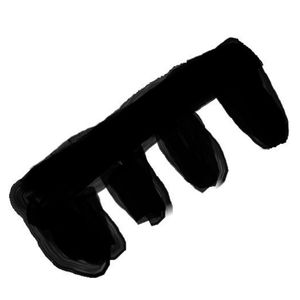
In paleolithic art, a "pectiform sign" is a comb-shaped motif with a central line, from one side of which a series of lines extends at right angles.
According to research conducted by Canadian prehistorian Genevieve von Petzinger, it is one of only 32 abstract symbols present in Upper Paleolithic art, between 40,000 and 10,000 BC.
How Prevalent are Pectiforms?
Pectiform pictographs are present at 8 ice age sites in France, or roughly 5 percent of the total number.
Sign types of similar popularity include: Aviforms (7%), Serpentiforms (7%), Zigzags (4.5%), and Spanish Tectiforms.
Dating
The "Pectiform sign" occurs in only two periods of the Upper Paleolithic: namely, the Gravettian (30,000-20,000 BC), and the Magdalenian (15,000-10,000 BC).
After a faltering start in the Gravettian, it disappears completely during the Solutrean (20,000-15,000 BC), before reappearing in the Magdalenian.
Geographical Distribution
The Gravettian and most of the Magdalenian pectiforms are located in the Dordogne/Lot region, with two more sites near the Pyrénées, and one in the Ardèche.
If the search was widened to include Spanish caves, the sign type would almost certainly be more prevalent. La Pileta Cave near Malaga, for instance, is known for its comb-like pectiform signs.
For more details about decorated caves in France and Spain, see: Franco-Cantabrian Cave Art.
Which Caves Contain Pectiform Signs?
Pectiforms are found in the following French caves:
- Cantal Cave, Lot
- Etxeberri, Basque Country
- Gabillou, Dordogne
- La Roque, Dordogne
- Le Cuzoul-des-Brasconies, Lot
- Les Fieux, Lot
- Marsoulas Cave, H.Garonne
- Rouffignac, Dordogne
- Sainte-Eulalie Cave, Lot
[Source: Petzinger (2005).]
Meaning of Abstract Symbols in Caves
Abstract signs outnumber animal pictures in paleolithic caves by more than two to one. Engraved or painted, they adorn cave walls like graffiti. So what do these weird motifs mean?
On the face of it, a symbol is a symbol: meaning, it symbolizes or 'stands for' something.
So when Paleolithic Man drew (say) a pectiform, he was most likely expressing a specific idea he had in his head.
This is quite significant, since the use of 'art' to express something abstract or conceptual, is a key indicator of cognitive development.
This doesn't mean every squiggle at Lascaux has a deep meaning: far from it. Many signs may say no more than 'up', 'down', 'forward', 'back', 'night, 'day' and so on.
Nonetheless, this type of symbolic cave art is seen as an important marker in cultural advancement and a precursor of written language.
So even though we may not know exactly what these signs and symbols mean, we can at least appreciate their general function: namely, to permit the communication of information.
See also our article on the Purpose and Meaning of Cave Art.
Related Articles
For more about these mysterious signs, see the following articles:
- Finger Fluting
So-called 'macaroni' - Half-Circle Signs
Semicircular images - Handprints
Positive hand and palm prints - Hand Stencils
Outlines of hands - Line Signs
Drawn with single stroke - Open-Angle Signs
Like a horizontal V-sign - Oval Signs
Egg-shaped motifs - Penniforms
Feather-shaped motif - Quadrangles
4-sided images - Reniform symbol
Kidney-shaped sign
References
(1) "Making the Abstract Concrete: The Place of Geometric Signs in French Upper Paleolithic Parietal Art." (2005) (Thesis) Genevieve von Petzinger. University of Victoria, Canada.
(2) "Journey Through the Ice Age." P.G. Bahn, J. Vertut. (1997). Berkley: University of California Press, 1st edition. ISBN-13: 978-0520213067.