
Unciform Sign
Prehistoric Hook-shaped symbol
Used in paleolithic cave art
CONTENTS
- What is an Unciform Sign?
- How Were They Produced?
- Description of an Unciform Sign
- How Prevalent are Unciform Signs?
- How Old Are Unciform Signs?
- Why Abstract Signs are Important
- What is the Meaning of Unciform Signs?
- Related Articles
- References
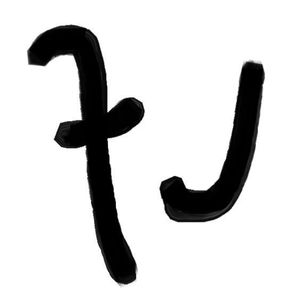
What is an Unciform Sign?
In prehistoric art, the hook-like "Unciform Sign" is one of 32 abstract symbols, documented by Stone Age sign-expert Genevieve von Petzinger, that were used to decorate caves during the era of Upper Paleolithic art (40,000-10,000 BC).
Compared to more common symbols, such as dots or ovals, and penniforms, unciforms are comparatively rare.
How Were They Produced?
"Unciform signs" were created in the same way as any other art of the period.
Either, they were painted - typically in red (ochre) or black (manganese dioxide) - or else they were carved into a stone surface with a burin-type tool.
Mostly, signs were a form of cave art, but on occasions they also appeared on items of portable art - see, for example, the Blombos Cave engravings (71,000 BC).
Description of an Unciform Sign
An Unciform pictograph is shaped like a hook (in French "crochet"). Think of a lower-case j-sign without the dot. Sometimes it is crossed: like a lower-case f-sign.
The etymology of the unciform motif, or how it came to be used thousands of years ago in paleolithic art, is anyone's guess.
Was it inspired by the shape of a fish-hook? Does it resemble some kind of natural object? Whatever its provenance, it resonated with Stone Age artists and their audience.
How Prevalent are Unciform Signs?
"Unciform signs" are present in Chauvet Cave but few other caves in France.
They were described in 2010 by Michel Lorblanchet (he called the sign type "crochet").
They are also one of the latest sign-types to be documented by Petzinger, who is compiling a master database of paleolithic cave signs used across Europe.
According to Petzinger, unciforms are found at only five cave sites in France, although the sites span the entire cultural spectrum of the Upper Paleolithic, from the Aurignacian through to the final Magdalenian period.
They include two sites in the southwest of France, two in the southeast, and a single site in the Pyrenees near the border with Spain.
Petzinger is of the opinion that - due to the high number of decorated caves across the border in Cantabria, the Asturias and the Basque region - the sign may have been adopted by Spanish cave artists.
Likely candidates include: Cave of La Pasiega and El Castillo Cave in Monte Castillo, and Altamira Cave near Santillana del Maro.
Also, there are several Basque caves of importance that are less well explored than other sites of Franco-Cantabrian art.
They include: Atxurra Cave (Berriatua), Ekain Cave (Zestoa), Altxerri Cave (Aya) and Santimamiñe Cave (Kortezubi).
How Old Are Unciform Signs?
The oldest Unciform symbols have been indirectly dated to about 30,000 BC, at the end of the Aurignacian culture.
Why Abstract Signs are Important
Although they look dull in comparison with animal paintings, prehistoric cave signs are a significant feature of Stone Age culture in Europe.
They are present in caves and on open-air rock surfaces, and outnumber animal paintings by 2 to 1.
They are also found engraved on various items of mobiliary art including necklaces, water containers, perforated batons of insignia, stone tools and weaponry.
Such widespread use makes them important to their creators and to anyone studying them.
Origins
Abstract signs are also found on much of the world's oldest art, dating as far back as the Lower Paleolithic.
Among the oldest are cupules (created by percussion), lines and zigzags, as well as half-circles and crosshatch symbols, some of which were produced by Homo erectus, our distant ancestor, as well as Homo neanderthalensis and modern Homo sapiens.
See, for example, the Daraki-Chattan cupules in India, the zigzags on the Trinil shell engravings in Java, the lines on the Bilzingsleben engravings in Germany, and the crosshatching on the Diepkloof ostrich shell engravings in South Africa.
Graphic Communication
A number of archaeologists and anthropologists continue to speculate about the graphic communication potential of cave signs.
After all, abstract symbols or markings must surely symbolize something. If they do, this would confirm that modern man developed an understanding of symbolic thinking, which is seen as a key indicator of cognitive progress.
Some researchers also believe it is conceivable that certain complex signage - the example they quote is usually the panel of signs known as "The Inscription" at La Pasiega Cave - represents a primitive writing system.
Hunter Gatherer Culture
At the end of the day, abstract symbols are important because they shed light on early human life.
When a sign in one cave is adopted by artists in another, it suggests contact between the two. Thus by monitoring the distribution pattern of these signs and symbols, we can see how early hunter-gatherer communities cooperated in trade and other matters, and how life evolved on the European tundra.
What is the Meaning of Unciform Signs?
Like all cave markings we have no idea who created them, or why.
We know they - like most cave painting - were produced in deep caves that remained uninhabited except for a core team of artists and labourers. We know signs are almost always associated with the animal figures in the caves, but we don't know how or why.
So we have no hard evidence to support any of the many theories on the subject.
Perhaps Artificial Intelligence (AI) will be able to crunch the data and provide us with a better understanding of why these signs were painted on so many cave walls, thousands of years ago.
See also our article on the Purpose and Meaning of Cave Art.
Related Articles
For details of other abstract signs and symbols used during the Stone Age, see the following articles:
- Scalariform
Ladder-shaped sign - Segmented Cruciform
Cross without a centre - Serpentiform
Snake-like symbol - Spanish Tectiform
Quadrangular symbol only in Spain - Spiral
Any spiral shape - Tectiform
Roof-shaped sign - Triangle Sign
Geometric symbol - W-Sign
Lower-case letter 'W' - Y-Sign
Shaped like the letter - Zigzag
Shaped as normal
For more on the chronology of cave symbols, see: Prehistoric Art Timeline (540,000 BC).
References
(1) "The First Signs: Unlocking the Mysteries of the World's Oldest Symbols." Genevieve von Petzinger. Atria; Illustrated edition (28 Mar. 2017) ISBN-10: 1476785503. ISBN-13: 978-1476785509.
(2) "Art pariétal - Grottes ornées du Quercy." (Cave Art: The Decorated Caves of Quercy) Michel Lorblanchet. 2010. Paris: Rouergue. ISBN: 2812601647